2026 CRNA Week
CRNAs: The Heart of Anesthesia.
In countless operating rooms, delivery suites, and trauma settings across the country, you’ll find CRNAs practicing the science and heart of anesthesia. These highly trained professionals guide patients through their most vulnerable moments with unmatched skill, compassion, and reassurance. Whether it’s a child undergoing their first operation, a wounded soldier on the front lines, or a senior facing a crucial procedure, CRNAs are the anesthesia experts there to keep their patients safe, comfortable, and cared for.
National CRNA Week celebrates the 75,000+ Certified Registered Nurse Anesthetists and residents in nurse anesthesiology programs across the United States. Join us in honoring these trusted professionals and the lives they touch every day during National CRNA Week 2026.
 Please send your pictures from CRNA week to Liv at li*@***na.org.
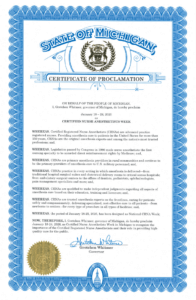
The State of Michigan Certificate of Proclamation for the 2026 CRNA Week.
CRNA Week 2026: Michigan Nurse Anesthetists Celebrate Service, Warn of Federal Policy Changes That Could Restrict Access to Care
As Michigan recognizes National CRNA Week from Jan. 18–24, the Michigan Association of Nurse Anesthetists (MANA) is honoring the essential role Certified Registered Nurse Anesthetists (CRNAs) play in delivering high-quality anesthesia care across the state. At the same time, MANA is cautioning that recent federal policy proposals could significantly limit the future anesthesia workforce, impacting access to surgical and obstetric services across Michigan.
CRNAs are uniquely critical in Michigan’s healthcare system. They are often the primary anesthesia providers in rural and underserved regions and work in collaboration with surgeons, obstetricians, emergency teams, and critical care professionals to support patients through some of the most vulnerable moments of their lives.
But federal actions currently under consideration may make it far more difficult for students to pursue the advanced doctoral education required to enter the profession.
Proposed changes to student loan classifications by the Trump administration and the elimination of Graduate PLUS loans through H.R. 1 (the “One, Big, Beautiful Bill Act’) would sharply limit the financial aid available to nurse anesthesia students, despite the intensity, clinical rigor, and full-time demands of these programs. In particular, the U.S. Department of Education no longer classifies nurse anesthesia programs as professional degree programs, significantly cutting federal loan opportunities.
“We rely on a steady pipeline of highly trained CRNAs to keep operating rooms running, labor and delivery units open, and surgical care accessible in communities of all sizes,” said Gena Welch, DrAP, CRNA, president of MANA. “If future students cannot afford to complete the education and clinical training required, Michigan hospitals will feel the consequences almost immediately.”
Welch noted that the proposed federal loan limits fail to reflect the reality of nurse anesthesia education, which is comparable in length, complexity, and clinical responsibility to other high-acuity health professions.
“This is not just a workforce issue; it’s a patient care issue,” Welch said. “Policies that restrict access to CRNA education ultimately restrict access to anesthesia services for all Michigan patients.”
As CRNA Week highlights the dedication, education, and compassionate care CRNAs bring to patients every day, MANA is urging federal leaders to ensure that the future of the profession remains strong.
“Michigan needs more CRNAs, not more barriers,” Welch said. “Supporting the next generation of anesthesia providers is essential to maintaining safe, timely access to care across our state.”
Watch this Information Video on the History of CRNAs.
Michigan Association of Nurse Anesthetists
37637 Five Mile Rd #399
Livonia, MI 48154
734-477-0328
2024 Copyright Michigan Association of Nurse Anesthetists